Welcome to the Philippines, dear traveler! Visiting this beautiful country is one of the best travel decisions you can make.
Survival in any foreign country entails that you must have a working vocabulary of at least 10 words or expressions in the local language. This will not only be useful for communicating your needs, but will also gain respect and goodwill from the locals.
While about 56.63% of Filipinos are able to communicate in English in some way (speak, read, write and think), it would still be convenient for you to express some words in Filipino to make your message clearer.
Here are 10 of the most important Filipino phrases you should learn before venturing out:
Magandang araw (Good day) — By nature a courteous people, Filipinos usually begin conversations with this greeting even among themselves, whether they are speaking to strangers or not. You can also say these greetings based on the time of day Magandang Umaga (Good Morning), Magandang Hapon (Good Afternoon) or Magandang Gabi (Good Evening).
Kumusta (How are you?) — Here’s another conversation opener almost always used among Filipinos. It is more casual and can be used any time of the day.
Pwede pong magtanong? (May I ask you something?) — As a traveler, you may not always be able to rely on GPS or guidebooks to get around. This question is handy for getting or confirming information about various things, from bus stop locations to restaurant entrees.
Salamat (Thank you) — Saying thanks is a universal practice across cultures. You need to thank people after you request for their services or for information. This will surely bring cheer and positive feelings, no matter how inconvenient your request may be.
Oo (Yes) — This is much better than just nodding your head. It shows that you have made the effort to learn the language and will surely elicit admiration from your listener. If speaking to a person older than you, use the more respectful “Opo.”
Hindi (No) — Just like “Oo”, “hindi” helps you communicate your needs, especially if you are making purchases or dining at a restaurant. It is used for expressing a refusal or a denial. If speaking to a person older than you, use the more respectful “Hindi po.”
Magkano? (How much?) –It’s always good to know how to ask for prices in any language. Being able to say this may even warm you to the other party and can get you a good discount.
Saan ang…? (Where is…?) — This question phrase usually follows after “Pwede pong magtanong?” You can get information about locations and directions. The local may even assist you in getting the right transport or show you the place if it’s nearby. Be sure to say “Salamat” after you reach your destination.
Paalam (Goodbye) — When you’re ready to leave a location and part from friends, this is the appropriate phrase to use. You’ll always be remembered for knowing how to say this (and other Filipino words) and you’ll expect a very warm welcome on your next visit.
Po — This has no English translation. It is a typically Filipino word used to show respect toward the other party. It can be used with people your age or older. (You don’t use it with children.) You can use it after the other phrases in this list. Use it often, and everyone will really be nice and accommodating in return.
You’ll be relieved to know that Filipinos are very forgiving and considerate if ever you mispronounced these phrases. But it will always be good to practice them first with a Filipino friend before trying them on the street in order to avoid getting lost in translation. You can also watch this Youtube that I found so you could practice:
https://youtube.com/watch?v=KoSc5Tv3BAk
Enjoy your stay, and try learning even more Filipino words as you do!
What other Filipino words do you think foreign tourists should know? Share it to us in the comments.
Welcome to the Philippines! As you may already know, one of the star attractions of this country is the jeepney. Originally a military vehicle used by the Americans during the second World War, the jeepney has since evolved into the cheapest and most available form of mass transportation. In fact, your travel experience in the Philippines won’t be complete until you get the thrill (or horror) of riding one of these.
The jeepney, or “jeep” for short, is easily recognizable because of its excessive decorations, gaudy colors, ubiquitous signages and messages, and incessantly noisy engine. There are only two rows of long sofa-like seats at the back with capacities ranging from seven to ten passengers per side (depending on the perception of the driver). The front part can seat three people: the driver, the conductor, and one passenger. The start and end destinations of the jeepney’s route are painted on both sides and also at the lower part of the windshield. Most jeeps are non-airconditioned and have large open windows with either roll-down curtains or sliding panes to keep off the rain.
You may have also heard of the notorious guys who drive these monstrosities. They are marvelous multi-taskers, as they are quite capable of doing several things at once: drive, collect fares, count change, talk, listen to the radio, and keep track of any passenger who forgets to pay. In recent years, drivers also have assistants sitting next to them, usually their spouses who want to make sure that they are keeping their eyes on the road and not on the ladies. These assistants enable the driver to concentrate on finding the speediest and most reckless ways of reaching their destination.
The above descriptions may sound daunting to first-time jeepney riders, so here are a few tips to guide you and help make your jeepney ride a truly pleasant and memorable experience, if you live to tell the tale.
Know which route to take.
You can find these out from the hotel personnel, security guards, cops, or just about any pedestrian on the street. Also, know where to find the jeeps.
Get on and off with haste.
Jeepney drivers are willing to wait only several seconds for passengers to board or get off. The important thing is not to step on anyone’s foot as the aisle is pretty narrow. Find the nearest available empty seat and sit down immediately, or you could risk flying off your seat by the driver’s frequent jack-rabbit starts.
Take as little seating space as possible.
This is especially hard for long-legged or wide-bottomed folks. In the driver’s interpretation, a standard seat means only a part of your bottom is actually sitting, while the rest is jutting out. At terminals, drivers will often make sure that there are at least 10 people on each side regardless of their sizes. You can always hold onto the overhead bars to balance yourself during the rough ride.
Pay with small change if possible.
As much as possible, pay the exact amount. You can ask the driver, conductor, or a fellow passenger about the fare. There have been cases of drivers who failed to provide the right change for large bills.
Use proper timing to pay.
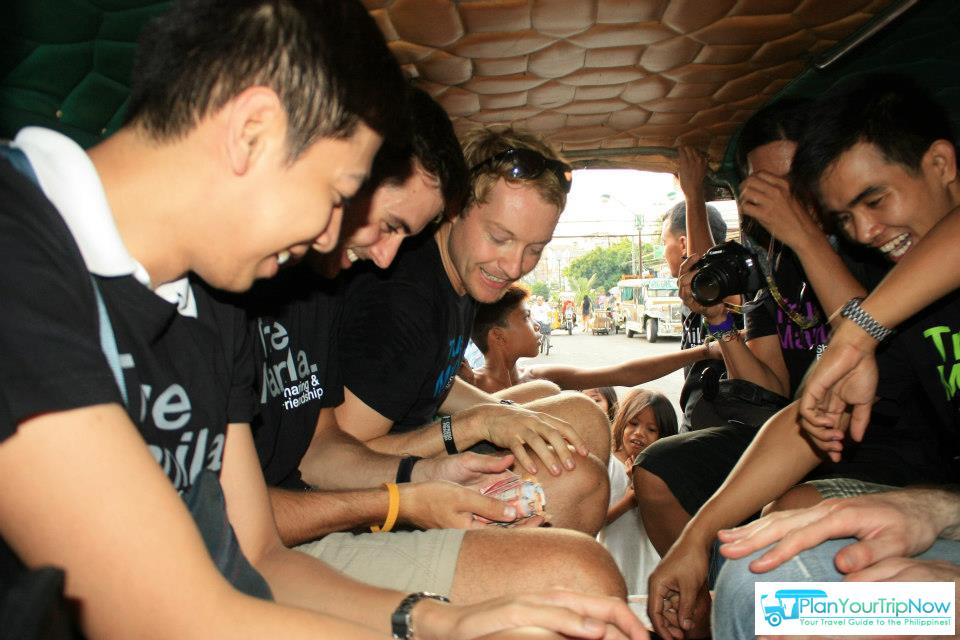
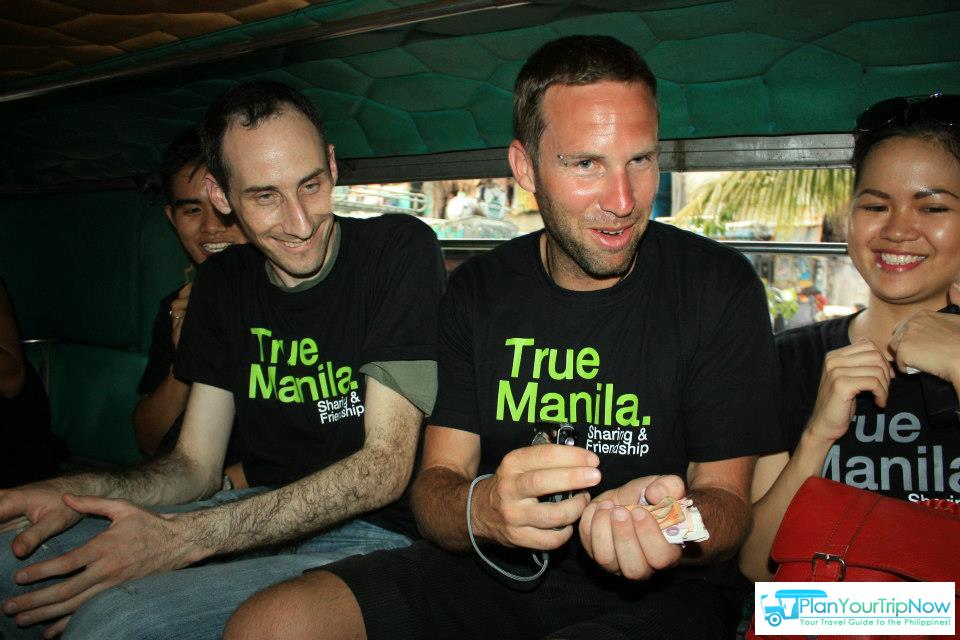
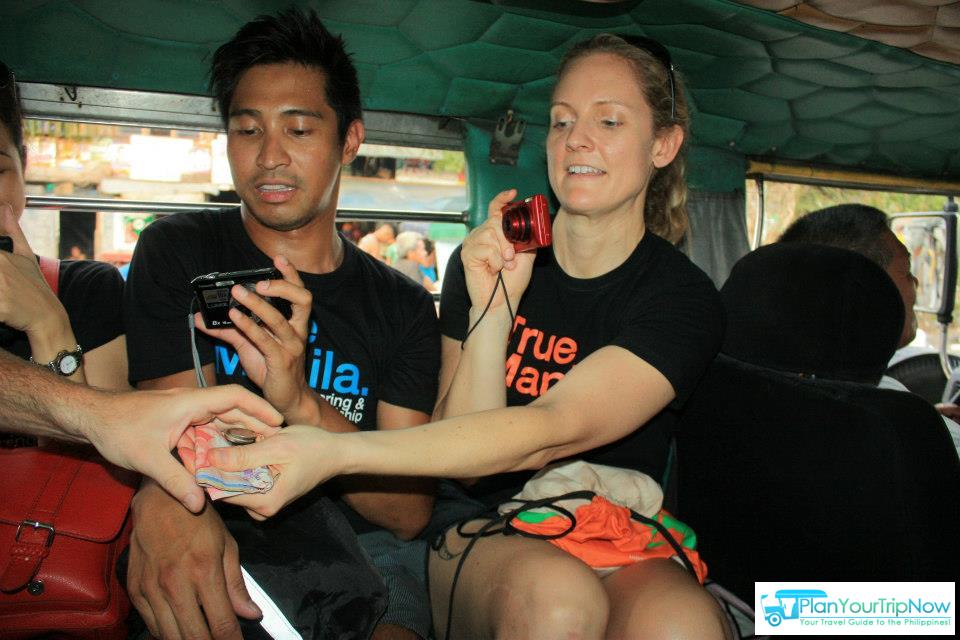
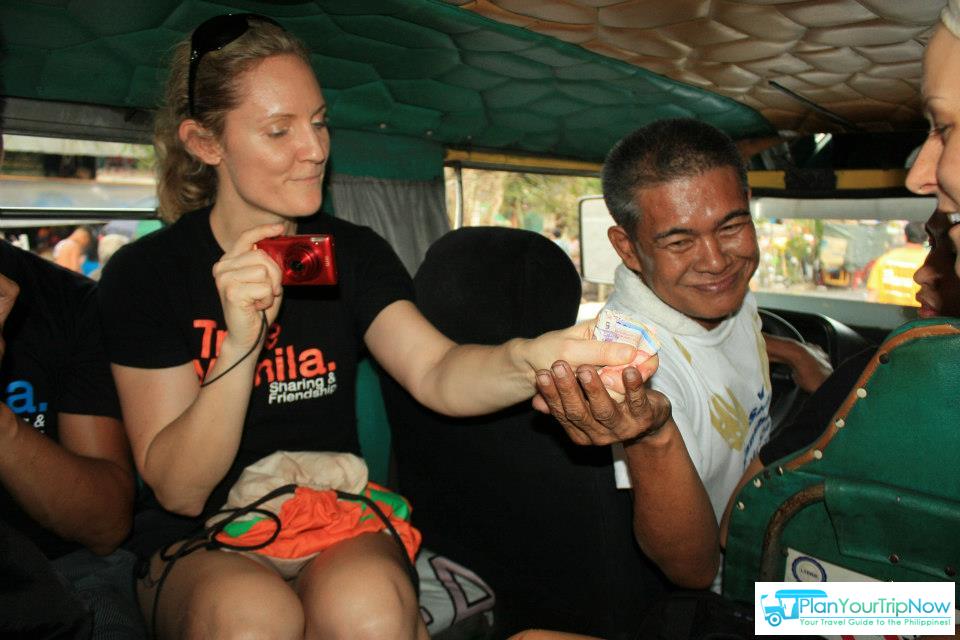
Some passengers unwittingly insist on paying the driver while he is busy changing gears or making turns, not realizing that this can cause accidents. Take the chance to pay while the jeep is stationary, such as at stoplights, terminals, or jeepney stops. As a custom, passengers at the back can pass the fare to fellow passengers next to them, until the money reaches the front.
To pay, just say “Bayad po” (translation: here’s my payment). If you are seated far from the driver, people would usually pass your fare until it reaches the driver or his assistant. But sometimes, people won’t notice that you are already ready to pay. Try extending your hands and politely say “Paki-abot po” (translation: please pass my fare)
Bayad Po
Paki-abot po
That’s how it’s done!
Don’t push or jostle.
Even in a crowded jeepney, courtesy is still the rule. Seats are usually given up to female and elderly passengers.
Use proper ways to signal a stop.
You can either say “Para po” or “Sa tabi lang po.” Some passengers knock or tap the ceiling or the sides of the jeep but many drivers detest this. For your convenience, most jeeps now have cords on the ceiling attached to buzzers to alert the driver. If you’re not sure where you should get off, immediately inform the driver or conductor at the start of your ride. Or if you know where to get off, alert the driver at least half a block from the stopping point.
There’s an easier and more convenient way now to get to go to Clark Airport (Diosdado Macapagal International Aiport) with the Trinoma Clark Airport Lounge.
This is a welcome development since I’ve had a pretty rough experience when I went I used the Clark Airport to go to Boracay last April 2012. My flight was really early at that time, 7am. I researched and can’t find an available bus that would take me to Clark Airport that early. (There were non-airconditioned bus in the south of Metro Manilathat ply the route but I live in the north and it is really not practical to go there at 3am.) I need to leave for the airport at about 3am just to get there in time for the 5am check-in procedures. So, I just pleaded to my dad to drive to Clark Airport 🙂 But, I can’t do it every time I have to fly via Clark Airport that’s why this is a really good news.
Here’s the leaflet that they gave away to promote the Trinoma Clark Airport Lounge.
Trinoma Clark Airport Lounge FrontTrinoma Clark Airport Lounge Back
I guess you should just use the phone number (+63-2-621-3673) when inquiring rather than using the www.clarkairport.com since not all the links work (sadly, just like every government website).
The Trinoma Clark Lounge is located on the ground floor of Trinoma just beside Mercury Drug facing North Avenue. It has seats available good for a lot of passengers and fully air-conditioned. There’s also a receptionist and security guard. There’s also the option to leave your luggage in the lounge and just stroll inside the mall instead of just waiting in the lounge.
Ticket Price is just P200 one way.
The Daily Bus Schedule is as follows:
From Trinoma To Clark Airport
[unordered_list style=”green-dot”]
3:00 AM
6:00 AM
8:00 AM
12:30 PM
3:00 PM
[/unordered_list]
From Clark Airport to Trinoma
[unordered_list style=”green-dot”]
1:30 AM
5:00 AM
9:00 AM
12:30 PM
2:30 PM
5:30 PM[/unordered_list]
Remember to call them first about the schedule since this might have already changed. They also don’t do ticket reservations. You can just come on the day itself. But again, inquire from them about this again just to be sure.
The currency of the Philippines is Philippine Peso which is also known locally as Piso. The peso sign is ₱, PhP or just simply P.
Philippine Peso exchange rate is 1 US dollar equals to about 43 Philippine Peso. And 1 Euro is about 58 in Philippine currency.
What are the Philippine Peso Denominations?
The coin denominations of the Philippine currency are: 1c, 5c, 10c, and 25c, 1 peso, and 5 pesos. The bill denominations of the Philippine currency are : 10, 20, 50, 100, 500 and 1,000 pesos.
[box type=”info” style=”rounded” border=”full”]Tip: When paying for small stores, bus, jeepney or tricycle fares always prepare smaller bills, a 100 pesos or less.[/box]
How to spot counterfeit Philippine Peso coins and bills?
Ok, so you are traveling to the Philippines and of course, you’ll need to exchange your dollars or euros or whatever currency you have and the last thing that you want to have is to get counterfeit Philippine peso and distribute it (which is punishable by law, btw). Although, fake money is not that rampant in the Philippines but it would still be useful to know some basics of spotting the counterfeit Philippine currency from the real ones. Fortunately, I used to be a bank teller and have some knowledge on ways of spotting counterfeit Philippine peso coins and bills.
Fake Philippine Peso coins
I think the 5 and 10 peso coins were the ones that have been counterfeited (counterfeiting one peso coins would just be useless and expensive). There are different ways to spot if the 5 and 10 peso coins are fake:
[unordered_list style=”arrow”]
The fake Philippine coins stick to magnets. 5 and 10 peso coins are composed of copper, nickel, aluminum and zinc while their fake counterparts are made of steel.
The texture of fake Philippine coins are rough due to the poor quality produced by stamping machines used to make the coins.
Some details may be missing, uneven or overly pronounced like in the letters and numbers, the countours of the hair and the profile of the face.
Fake Philippine coins are lighter and tend to rust. This is again due to them being made up by steel.
[/unordered_list]
Fake Philippine Peso Bills
During Christmas season, there are more fake Philippine peso bills that gets in circulation since it is the time of the year when Filipinos are spending lots of money buying gifts for everyone so it is the perfect time for syndicates to spread counterfeit philippine peso bills. Here are some ways to spot counterfeit Philippine Peso bills:
[unordered_list style=”star”]
The paper should feel rough to touch.
Watermark/silhouette of the portrait on the face of the note which can be viewed against the light.
Security fibers are embedded red and blue visible fibers scattered at random on the surface and can be readily picked off by using any pointed instrument.
Security thread which appears vertically on the side of the note and with text indicating the numerical value of the Philippine peso bill.
Microprint is the best way to determine if the Philippine Peso Bill is genuine since it is extremely difficult to pull off. In the fake money, the ink used to print the microprint spreads in the surrounding and is not readable. Bank tellers checks for microprint since this is the easiest way to catch a fraud. The locations of microprints are indicated here and the microprint text is “Central Bank of the Philippines or Bangko Sentral ng Philippines”.
[/unordered_list]
For the new generation Philippine Peso bills:
Philippine new generation currency / Photo from bsp.gov.ph
The Bangko Sentral ng Pilipinas, the Philippines’ central bank, release new notes last December 2010 with new design and improved security features. This vividly colored Philippine peso bills also features the different tourist destinations(yey!) in the country. Here are the security features of the new bills:
[unordered_list style=”tick”]
It feels more rough to touch since it is made up of cotton and Philippine abaca.
Increasing size of serial number
Security fibers
2mm wide security thread for P20 and 4mm wide stitch-like metallic security thread for 100, 200, 500 and 1000 peso notes with the initials of the BSP and the numeric denomination
Watermark now includes not only the silhouette image of the portrait but also the denomination
Concealed value on the smaller version of the portrait
P500 and P1000 peso bill have optically variable device patch which changes color when viewed at different angles
[/unordered_list]
Just to give you an idea how much some popular items cost in the Philippines:
a can of Coke: P20-P25 USD .60 cents
McDonald’s Big Mac: P125
Starbucks Hot Brewed Coffee (Tall): P95
Where can you exchange your foreign currency?
Foreign currency can be easily exchanged at your hotel, and in most of the large department stores, banks and authorized money changer or pawnshops like Western Union, M Lhuillier and Cebuna Lhuillier.
Banks are known to offer not so good rates but it is the safest way since you’ll be sure that you won’t get scammed. The best rates can be found on the money changer shops and pawnshops.
Check the Philippine peso exchange rate online so you have an idea how much your money will be worth when exchanged.
Ask around fellow tourists or Filipino friends where you can exchange your money. The ones that I mentioned above are the reputable ones but there are many money changer shops that also provide good service, again ask around.
Make sure that the money changer shops post their philippine peso exchange rate and not suddenly change it.
Some money changers are too fast with their hands. They would trick you as they count your money, they take some bills back and count it again so you appear to receive more than you actually do.
Keep your money hidden
[/unordered_list]
[/box]
If you ran out of cash, you can use your ATM, debit or credit card. Most large stores, restaurants, hotels and resorts accept major credit cards including American Express, Visas and MasterCard.
What foreign currencies can you exchange in the Philippines?
Overseas Filipino Workers are all over the world and sends money back to the Philippines so currencies like US dollars, British pounds, Euros, Canadian dollars, Australian dollars, Japanese yen, ASEAN and Middle East currencies can easily be converted in money changers especially in Metro Manila and other major cities. In the rural areas, it might be difficult to exchange currencies other than the US dollar so just be prepared.
Bringing foreign currency in or out of the Philippines
Any person who brings into or out of the Philippines foreign currency in excess of US$10,000 or its equivalent is required to declare the same in writing and to furnish information on the source and purpose of the transport of such currency.
Bringing in and taking out of the country Philippine currency in excess of 10,000 pesos
The taking in and bringing out of Philippines of Philippine currency in excess of PhP10,000 is strictly prohibited, and any need carry any currency in excess of the said amount must be given authorization by the Bangko Sentral ng Pilipinas (BSP) Cash Division.
Violation of the 2 rules mentioned above may lead to seizure and sanctions, fines and / or penalties.
The major gateway to the Philippines is the Ninoy Aquino International Airport which is located in the capital – Manila. With the increasing number of tourist, the airports are being upgraded to handle more passengers and bigger planes. Here are some of the growing list of International Airports in the country which may be your ports of entry:
City/Municipality
Province
Airport Code
Airport name
Silay
Negros Occidental
BCD
Bacolod-Silay International Airport
Angeles
Pampanga
CRK
Clark International Airport
Davao City
Davao del Sur
DVO
Francisco Bangoy (Davao) International Airport
General Santos
South Cotabato
GES
General Santos International (Tambler) Airport
Cabatuan
Iloilo
ILO
Iloilo International Airport
Kalibo
Aklan
KLO
Kalibo International Airport
Laoag
Ilocos Norte
LAO
Laoag International Airport
Lapu-Lapu
Cebu
CEB
Mactan-Cebu International Airport
Parañaque/Pasay
Metro Manila
MNL
Ninoy Aquino (Manila) International Airport
Puerto Princesa
Palawan
PPS
Puerto Princesa International Airport
Morong
Bataan
SFS
Subic Bay International Airport
Zamboanga City
Zamboanga del Sur
ZAM
Zamboanga International Airport
Aside from the international airports, there are also a number of domestic airports scattered all over the archipelago. You need to check-out which airport that you would use to a particular province and which airlines are servicing that route.
Most of the airlines operating in the Philippines are budget airlines. I think Philippine Airlines, the flag carrier, is the only full service airline. Thanks to these budget airlines traveling across the different islands is now much more convenient. Here are 5 major airlines operating in the country:
Major Airlines in the Philippines
Website URL:
Philippine Airlines
http://www1.philippineairlines.com/
PAL Express
http://www.flypalexpress.com/
Cebu Pacific
http://www.cebupacificair.com
Air Asia
http://www.airasia.com/ph/
Tiger Air
http://www.tigerairways.com/ph/en/
Sky Jet Air
http://www.skyjetair.com/
To make it easier to plan out your flights to the Philippines, you can use http://www.skyscanner.com.ph/
[box type=”info”]Guidelines[/box]
Do not make bomb jokes. Even just mere mention of bomb would get you in trouble. By trouble, I mean Prison!
Liquid, aerosol and gels in more than 100ml containers are not allowed in your hand carry luggage.
Arrive in the airport 3 hours in advance for international flights and 2 hours in advance for domestic flights.
Terminal fees are collected from passengers departing a particular airport. The fund is used for acquiring security equipments for the airport. The fee varies depending on the airport:
International departure: P200-750
Domestic departure on International airport: P200
Other Local Domestic Airports: P20-40
What’s your favorite airline in the Philippines? Tell me about your experience below.
This is just a part of a series of post about the different modes of transportation in the Philippines. If you are looking for Land or Air transport available in the country just click the hyperlinks.
by Sea
The Philippines is composed of 7,107 islands. If you’ll be traveling all over the country, you’ll eventually have to travel by sea. Here are the different means of transportation in the Philippines by sea:
RORO
Roll-on/roll-off ships ferry passengers, vehicles and cargoes from one island to another. If you are not in a hurry, you can try this plus the fare is much cheaper compared to planes. I’ve recently rode a RORO from Caticlan (Boracay) to Batangas. The ship has good accommodations and facilities. The service is good too. You can check-out their website here: http://travel.2go.com.ph/
2GO RORO
Fast Craft/Fast Ferry/Catamaran
There are also fast craft vessels that you could use for going to one island province to another. These are popularly known as the SuperCat (although SuperCat is actually a name of one of the companies offering this service). It is more commonly used in the provinces in the Visayas where the island provinces are just within a few hours from each other. The fare is a little bit high but you’re paying for the comfort and arriving in your destination faster.
Here are the websites of some companies offering this service:
SuperCat website
http://www.supercat.com.ph/index.asp
Weesam Express
http://www.weesamexpress.net/
Ocean Jet
http://oceanjet.net/
Bangka/outrigger canoe/pumpboat
The most popular transporation in the Philippines on the seas is the bangka. They are used for transportation and fishing. They come in different sizes. The capacity ranges from 2 to a 100 persons. It can be just paddle power or motorized. Similar to jeepneys, they are colorful and have cool and sometimes funny names. This is what you would usually use for trips in areas that have no access to the bigger sea vessels mentioned above. This is used for island hopping, snorkeling, diving and ferrying passengers.
Since you’ll be traveling all over the Philippines, you should know what different modes of transportation that you can take to get around. There’s a good mix of traditional and modern transportation in the Philippines from trains to jeepneys and from ferries to bangka (outrigger canoes). There’s quite a lot of options to choose from getting to point A to point B, not to mention pretty cheap too.
You can also see the resourcefulness and creativity of Filipinos when it comes to designing, painting and personalizing their tricycles, jeepneys or bangka.
Let’s now discuss each of these means of transport. I have divided the different modes of transportation into 3: by land, by sea and by air.
by Land:
Train
The rail transport system in the Philippines consists of a commuter rail and rapid transit. As of now, the train system is only servicing the areas in Southern Luzon and Metro Manila. Unknown to many, there used to be a train system that runs from Northern Luzon to Southern Luzon but because of war and neglect the some parts of the network has been unusable for years. The government has now revived Southern Luzon(suspended for on-going repairs) route but the revival of the Northern Luzon route has been put on hold because of controversies.
Currently, the government is developing the country’s first monorail system which is being pilot tested in the campus of a state university. This would greatly improve the condition of transportation in the Philippines especially in the urban areas but until then you’ll get to enjoy more of the traditional mode of transportation.
In Metro Manila, there are 3 train networks. The LRT 1, LRT 2 and the MRT 3. These 3 lines are interconnected: LRT 1’s EDSA-Taft Avenue station is connected to MRT 3’s North Avenue Station. LRT 2’s Recto Station is connected to LRT 1 via Doroteo Jose station. MRT 3 has also been connected to Roosevelt Station of the extended LRT 1.
You can also view the live cctv streaming of each MRT station to plan ahead your trip
Guidelines when using the LRT and the MRT:
No inspection, no entry policy. This involves frisking and they ask you to open your bags.
Gift-wrapped items will have to opened for inspection. (So, if you are coming from the mall with a gift wrapped item just don’t take the train. You could just use a nice paper bag instead or just gift wrap the item on your own at home)
Bringing in of deadly weapons, food and drinks, inflated balloons, and flammable materials is also not allowed.
Bulky and long objects is also a no-no. You can’t bring your big luggage when using the train. There’s no train station near the airport so you don’t really have to bring your luggage there.
Persons who are under the influence of alcohol and drugs will not be allowed to enter.
Philippine National Railways
The Philippine National Railways or simply PNR have commuter rail service (known as Metro Commuter/Commuter Express/Commex) in Metro Manila and another one that serves the Southern Luzon (Manila-Bicol route) area. It is one of the oldest railway in Asia but has been operating on and off for quite a while. It has recently been rehabilitated and is now a good alternative mode of transportation.
According to PNR website, the Manila-Bicol route is currently suspended because of ongoing repairs but anyway, here’s their route map for Manila-Bicol:
PNR Route Manila-Bicol
Some tips:
During rush hour, the trains would be really packed. If you can postpone your travel a little bit and just use the train at around 10am-3pm it would be less crowded.
Watch out for your valuables.
If the next station is the one you are supposed to get off, prepare to make your way through near the exit one station ahead or else you’ll run the risk of not getting off your stop.
Bus
The buses in the Philippines are operated by private companies. They are divided into two: city and provincial. The routes are self explanatory. The city buses ply the major thoroughfare of cities while the provincial buses..well goes to the provinces. They have signs infront indicating where their destination is. There are both aircon and non-aircon buses.
In Metro Manila, the provincial buses have terminals where you can just hop on to your destination. The main bus terminals in Metro Manila are located Monumento, Cubao, Buendia and Pasay.
For the city buses, you can just use the proper bus stops. Just use the route map below for reference:
MMDA bus segregation. Illustration from GMA News
When you are in the provinces, you can pretty much just hail a bus as it pass by.
Jeepney
The jeepney is the king of public transportation in the Philippines. You can find it all over the country. It is the most popular and affordable means of transportation in the Philippines. You can see it not just transporting passengers but also hauling goods and agricultural products.
Who would have thought that the World War II jeep abandoned by the Americans would become one of the most recognizable Philippine icon. You can easily spot these colorful and jeepneys all over the Philippines.
So, these are a bit more stylish.. fyi, most jeepneys don’t look like these.
Most jeepneys are non-airconditioned. I have only seen airconditioned jeepneys in Makati.
The jeepneys ply a designated route. The routes are usually written on the sides of the jeepney and you can see the destination that it is going to in the windshield.
Useful tips:
When paying for the fare, just extend your arms towards the driver and say ‘Bayad Po’ which means ‘here’s my fare’. Then, you can tell the driver where you want him to drop you.
If you are too far away from the driver, just say ‘Paki-abot po’ and the other passengers would pass your fare to the driver.
To have the jeepney stop on your destination, just shout, ‘Para po’ or ‘Lugar lang po’ (which is the one used in Cebuano speaking provinces).
If you have change, the driver would then pass it back to the passengers near him and they’ll pass it to you.
Always use coins or small bills when paying for the jeepney fare since the drivers might not have enough change especially during their first trip in the morning. Paying 100 pesos and up is usually frowned upon.
The minimum fare for the jeepney is 8 pesos for the 1st four kilometers.
Usually, the jeepney doesn’t leave the terminal unless it’s full so you’ll have to wait a bit.
UV Express Service
The UV Express Service are vehicles given franchise by the government to transport passengers. These vehicles are capable of transporting 10-18 passengers. It is popularly called FX after the brand Toyota Tamaraw FX which started these type of vehicles. They travels specific route and have designated terminals. Just like jeepneys and buses they have signages in their windsheild indicating their destination. They’ve become popular since they are airconditioned and can also take you much faster to your destination since they have fewer stops and pass through shortcuts. The usual price for an FX/Van ride is P20-P40.
I mentioned the FX/Van because you can also rent them for trips. They are pretty spacious and can fit several people including some bags. You can talk to the drivers in the terminal and just haggle for a better rate.
Taxi/Cab
The taxis/cabs are all over the metropolitan areas. I think this one doesn’t need much introduction. Just some tips:
Always remind the driver to use the meter. Some drivers would want to make a deal with you that they’ll take you to your destination for a certain price which is much higher that the price if you used the meter.
Know the general direction of where you are going. Some taxi drivers would go around in circles just to make you pay a higher rate even if your destination was just supposed to be one block away.
Tricycles
Every province have their own version of this three-wheeled motorized vehicle. It consist of a motorcyle and a sidecar. It can fit 3-8 people depending on the design of the tricycle. It is usually used for short trips.
They have also designated routes but you can also rent them for special trips. The fare is about P10/person and goes up depending on the distance.
Pedicabs/Sidecar
Pedicabs are the unmotorized version of tricycles. It is cheaper and environment friendly 🙂 Just be considerate to your driver and don’t make him travel uphill.
Habal-habal/Skylab
I haven’t tried riding a habal-habal yet. I find it too scary and dangerous but if you are up for a unique experience you can give it a try. A habal-habal is a motorcyle with extended seats to accommodate more passengers.
The habal-habal is popular in areas where the jeepneys and tricycles cannot go because of rough, steep and narrow terrain.
Kalesa
You can still find this classic horse drawn carriage in Intramuros and Binondo, the Chinatown of Metro Manila. These are rarely used nowadays except in tourist spots and some rural areas.
Rent a car
Well, I haven’t really availed of a rent-a-car service here but just in case you’re looking here are some popular companies that I’ve heard of:
It depends on how long you are planning to stay. The citizens of the countries below are allowed to stay in the Philippines for up to 30 days without the need for a visa provided they hold a valid ticket to return to their country or to their next destination. Also, the passport should still be valid for at least 6 months beyond the contemplated period of stay. However, if you’re planning to stay for more than 30 days, you will need a tourist visa.
From the website of the Department of Foreign Affairs, nationals from the following countries are allowed to enter the Philippines without a visa for a period of stay of thirty (30) days or less:
(*Updated November 2014*)
Andorra
Angola
Antigua and Barbuda
Argentina
Australia
Austria
Bahamas
Bahrain
Barbados
Belgium
Belize
Benin
Bhutan
Bolivia
Botswana
Brazil*
Brunei Darussalam
Bulgaria
Burkina Faso
Burundi
Cambodia
Cameroon
Canada
Cape Verde
Central African Republic
Chad
Chile
Colombia
Comoros
Congo
Costa Rica
Cote d’Ivoire
Croatia
Cyprus
Czech Republic
Democratic Republic of the Congo
Denmark
Djibouti
Dominica
Dominican Republic
Ecuador
El Salvador
Equatorial Guinea
Eritrea
Estonia
Ethiopia
Fiji
Finland
France
Gabon
Gambia
Germany
Ghana
Greece
Grenada
Guatemala
Guinea
Guinea Bissau
Guyana
Haiti
Honduras
Hungary
Iceland
Indonesia
Ireland
Israel*
Italy
Jamaica
Japan
Kazakhstan
Kenya
Kiribati
Kuwait
Kyrgyzstan
Lao People’s Democratic Republic
Latvia
Lesotho
Liberia
Liechtenstein
Lithuania
Luxembourg
Madagascar
Malawi
Malaysia
Maldives
Mali
Malta
Marshall Islands
Mauritania
Mauritius
Mexico
Micronesia
Monaco
Mongolia
Morocco
Mozambique
Myanmar
Namibia
Nepal
Netherlands
New Zealand
Nicaragua
Niger
Norway
Oman
Palau
Panama
Papua New Guinea
Paraguay
Peru
Poland
Portugal
Qatar
Republic of Korea
Romania
Russia
Rwanda
Saint Kitts and Nevis
Saint Lucia
Saint Vincent and the Grenadines
Samoa
San Marino
Sao Tome and Principe
Saudi Arabia
Senegal
Seychelles
Singapore
Slovak Republic
Slovenia
Solomon Islands
South Africa
Spain
Suriname
Swaziland
Sweden
Switzerland
Tajikistan
Thailand
Togo
Trinidad and Tobago
Tunisia
Turkey
Turkmenistan
Tuvalu
Uganda
United Arab Emirates
United Kingdom of Great Britain and Northern Ireland
United Republic of Tanzania
United States of America
Uruguay
Uzbekistan
Vanuatu
Vatican
Venezuela
Vietnam
Zambia
Zimbabwe
*The following are allowed to enter the Philippines without a visa for a stay not exceeding fifty-nine (59) days:
1. Holders of Brazil passports; and
2. Holders of Israel passports
The following are allowed to enter the Philippines without a visa for a stay not exceeding fourteen (14) days:
1. Holders of Hong Kong Special Administrative (SAR) passports.
2. Holders of Macau Special Administrative Region (SAR) passports.
The following are allowed to enter the Philippines without a visa for a stay not exceeding seven (7) days:
1. Holders of Macau-Portuguese passports
2. Holders of Hong Kong British passports. Where can I get a tourist visa?
If you would like to extend you stay in the Philippines, you will have to report to the Bureau of Immigration, secure an extension of stay and pay the corresponding immigration fees. Information on fees for extension of stay and other Immigration fees are available at the Bureau of Immigration website.
Did you get your tourist visa? Was it easy? Please share to use your experience on the comments 🙂
Image courtesy of photostock / FreeDigitalPhotos.net
The Philippines is an archipelago located at 13º00´ N, 122º00´ E. Just kidding! Who understands that?
It is in the Southeast Asia region. It is located just below China/Taiwan, above Indonesia/Borneo and on the right of Vietnam. Or you could just use the map below as your reference.
The Philippines is composed of 7,107 islands. The 3 main island groups are Luzon, Visayas and Mindanao.Philippine Map from www.drdf-uppi.net
What’s the capital?
The capital of the Philippines is Manila which is part of the National Capital Region (simply called Metro Manila) that is composed of 16 cities. It is located in Luzon.
What’s the language?
One of the official language is Filipino which is based on Tagalog, one of the dialects.
The other is English. The Philippines is the 3rd largest English speaking country just after the US and the UK. Most Filipinos speak and understand English. Some Filipinos don’t even speak Tagalog. They speak only their native dialect and guess what? English! So, you can pretty much strike up a conversation with anyone in English.
If you get lost, you can just simply ask for directions in English. I’m sure you’ll find some willing Filipinos to help you. Sometimes, they might not understand your accent or get shy but they can just easily grab someone to help you out.
How do I get around the Philippines?
The most common mode of transportation is the jeepney. There are also tricycles which you would use for shorter trips. Of course, there are also buses, taxis or cabs in urban areas.
You need to ride a plane or a boat to get to the islands.
For long boat trips, you can ride a RORO and for shorter trips like island hopping you can ride a bangka.
There are 6 major airlines in the country which offers great deals if you book ahead of time.
I’ll discuss more about the different modes of transportation here, here and here.
What’s the weather like?
The Philippines is a tropical country so expect it to be hot (Average Temperature: 78 degrees F or 25 degrees C)and humid (Average Humidity: 77%).
There are 2 seasons: dry and rainy. But the dry season can further be divided into two – cool dry and hot dry.
Seasons:
Rainy Season – June to November
Cool Dry Season – December to February
Hot Dry Season – March to May
I know you wanna know this! Internet cafes are available in urban centers and popular tourist spots. Wifi is also available in malls, coffee shops and hotels. You can also access the internet through 3G and 4G mobile networks. So don’t worry that much, you’ll still be able to update your facebook status, tweet and upload travel photos to the envy of your friends back home.
Will my cellphone work in the Philippines?
The mobile network band used in the Philippines are 900/1800, 3G 850/ 2100, 4G LTE, HSPA+ so you could pretty much use your phone here since most phones now are triband.
If you are planning to stay in the Philippines for a while and you’ll be making a lot of local calls, you should just probably buy a new prepaid SIM card which only costs around 30-40 pesos.
Electricity
Most tourist spots have electricity. There’s still a lot of areas in the Philippines that doesn’t have electricity though but usually these are remote areas like an island and mountainous regions. Some remote communities, resorts and hotels have their own generator to light up their places during the night.
If you are doing the off the beaten track type of traveling, of course, don’t expect the place you are going to have electricity.
Also, the Philippines uses 220 Volts AC, 60 Hz so if you have gadgets and equipments with you that’s only for 110 Volts you need a transformer to use it. Keep this in mind so you won’t end up with a toasted, useless gadget. Although, most hotels already have a socket for 110 volts it’s better to check first.
Some more facts about the Philippines:
Population: 96 Million
Local time: UTC/GMT+8 (No DST)
Currency: Philippine Peso (PHP) locally known as piso
Currency denomination: 5 cents, 10 cents, 25 cents, P1, P5, P10, P20, P50, P100, P200, P500, P1,000
Government: Democratic Republic
Religions: Roman Catholic, Protestant, Muslim and Buddhist
Country code: +63
Most popular dish: Adobo
Most popular beer: San Miguel Pale Pilsen and Red Horse